
One in Four: Widespread adoption and what it means for SW Colorado

An electric truck on road in the forest.
Ask me to sum up the state of the global EV industry in 2025 in a few words, and I would say: “One in four.”
That’s how many new light-duty vehicles sold worldwide last year were electric. Notably, that’s up from about 20% in 2024 – a jump of roughly 5 percentage points in a single year.
This number is even easier to appreciate when you look at the volume behind it. The world bought around 23.7 million EVs in 2025, up from 17.8 million in 2024. That’s roughly 33% growth year-over-year – or 6 million additional EVs sold in a single year.
In other words, EVs aren’t some slow, linear trend. The market is moving quickly, even if different places are moving at different speeds.
Take Norway, for instance. Almost all new cars registered there last year were electric. Yes, you read that correctly: almost all of them. Just shy of 96% to be exact. In December, that number was almost 98%. (If you’re wondering what the Norwegians' secret is, it’s tax incentives.)
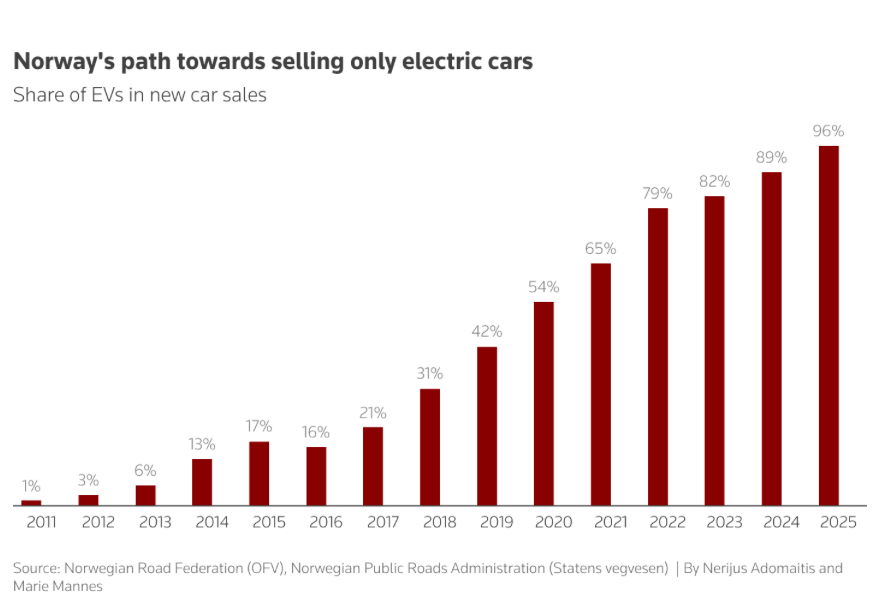
A graph of the percentage of new cars in Norway that are electric.
In China, another country that’s seen rapid EV adoption, EVs made up about 60% of new car sales. In Europe overall, it was about 25%; in the U.S., somewhere between 11% and 12%.
Scale It and They Will Come
The takeaway from all of this is where EVs become common faster, manufacturers build more models, suppliers scale up, and prices tend to get more competitive. Where adoption is slower, the experience can feel more uneven: Great options exist, but awareness, infrastructure, and price points take longer to spread.
Charging is the other piece that makes EV growth feel “real” to everyday drivers. By the end of 2024, the world had more than 5 million public charging points. Over 1.3 million were added in 2024 alone, and the total was up about 30% in a single year. Public charging has doubled since 2022, and about 65% of public chargers are in China. Big picture: The network is expanding fast, even if it doesn’t feel evenly distributed yet.
Then there’s battery costs, which are moving in the direction drivers care about most: toward affordability. As I mentioned in last month’s blog post, BloombergNEF reported average lithium-ion battery pack prices fell to $108 per kilowatt-hour in 2025, down about 8% from $118 in 2024. Lower battery costs don’t guarantee cheaper sticker prices overnight, but they do improve the math that makes EVs more accessible.
So What Does This Mean For Southwest Colorado?
First, as EVs move from “early adopter” to everyday reality, the pressure builds for charging to keep improving on the routes that matter to rural regions – highways, tourist corridors, and the long-distance drives many of us do routinely.
Second, falling battery costs are one of the biggest underlying reasons EVs can become more practical for households watching total costs over time, even when upfront prices still feel high.
Third, the growth in electric buses and trucks points to a future where more miles are driven without diesel exhaust. We mountain towns know to appreciate clean air.
The story of 2025 is simple: EVs are no longer the side plot. They’re increasingly becoming the main event.
